F A I T H
Experience certainly counts for more than it used to in the gallery. This is not to say that 'art' is any more or less important than it ever has been, but that somehow, culturally, we expect to encounter something more than just a collection of art objects in a space now. The integration of technology into the all day, everyday of contemporary life has had important implications upon many industries, and the arts have not - and cannot - be exempt.
Rosa's experience of David Bowie is illustrates an acknowledgement of this appetite for innovation - despite how ineffective she felt the experience of Sennheiser's sound guide may have been. For a 'blockbuster' exhibition in one of London's most popular art institutions, the decision to make a start at enhancing exhibition experience on such a large scale should be applauded - and through such a development, we can take the opportunity to consider the critical strengths and weaknesses of mobile interpretation and exhibition design within the gallery.
During last month's Museums and Heritage Show, D I S C O U R S E were excited by and really impressed with a talk from Antenna International, who provide a wide variety of top class guides and tours for galleries and museums. 'Experience Design: Evolving Mobile Data' was given by Jessica Taylor (Global Head of Digital Media) and Giles Pooley (Experience Designer at EMEA), and gave the audience not only an insight into what Antenna International delivers, but what enhancing experience through technology can mean for all kinds of art institutions. The context of our increasingly connected lives - particularly through the exponential growth of smartphone use - does result in the gallery's development into somewhere that is no longer discrete from the informational networks through which we operate. The challenge for companies like Antenna is to cut through the additional or unnecessary noise in order to give a gallery visitor the best experience possible of the art, and with this context in mind, content is incredibly important. Delivering a story using appropriate language and format is essential for engagement, and what is often helpful here is the use of a familiar device. Ensuring that people engage with digital possibilities needs to be very simple, and in some situations, allowing the personalization of interaction methods can be a perfect way to allow that visitor access to what Antenna referred to as that 'third space': the area of access that mediates the visitor and the art space.
As is obvious from this post as well as Antenna's fascinating (and very well delivered) talk, there are many questions and important tangents to such a discussion. But aside from these separate points of interest, its brilliant to see that galleries and museums are looking ahead for new ways to engage wider audiences with art - particularly through technology.

Showing posts with label Audio guide. Show all posts
Showing posts with label Audio guide. Show all posts

'David Bowie is' | Questioning sound tech's intervention
R O S A

Last Friday I went to the V&A's blockbuster exhibition 'David Bowie is'. This post notes how I found the viewing experience different/interrupted, as a result of the designed sound experience. Perhaps reflective of David Bowie's musical output, sound played a large role in the exhibition. To create this hybrid experience the V&A collaborated with sound specialists at Sennheiser, whose mission was to help the Museum 'bring together Sound and Vision' (Sennheiser, 2013). However, where sound experience can often strengthen the relationship between visitor and exhibit (in its provision of additional content), I found that in this case it distanced my relationship with the exhibits. Whilst the content of Sennheisers sound guide was both relevant and interesting, its all-encompassing and controlled nature made it difficult to fully engage with either the sound guide OR the collection. Different to others, this audio guide is not a 'guide' at all; instead audio info is triggered based on where the user is currently stood, removing the opportunity for viewers to navigate their own experience. Hopping around to find the right trigger spot, I began to resent the audio content for dictating my viewing experience. Overall, it seemed that the exhibition content was being relayed by too many voices (both active and contributing at the same time). Had the audio content been activated by the visitor's selection rather than triggered by their location, this may have minimised confusion between the multiple information sources, and minimised the audio guides control over the visiting experience.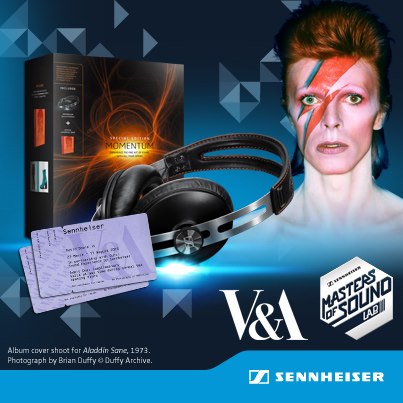
This post is critical in its discussion to recognise how tech can hinder a viewing experience as much as it can heighten it. Perhaps curating the work of a Musician/Artist whose career is multi-faceted (fashion, music, artwork, video, design etc) requires a similarly multi-faceted viewing experience. However, when introducing these new dimensions the audiences' liberty to engage with art independently should never be forgotten.
Click here for the Sennheiser press release.
Subscribe to:
Posts (Atom)